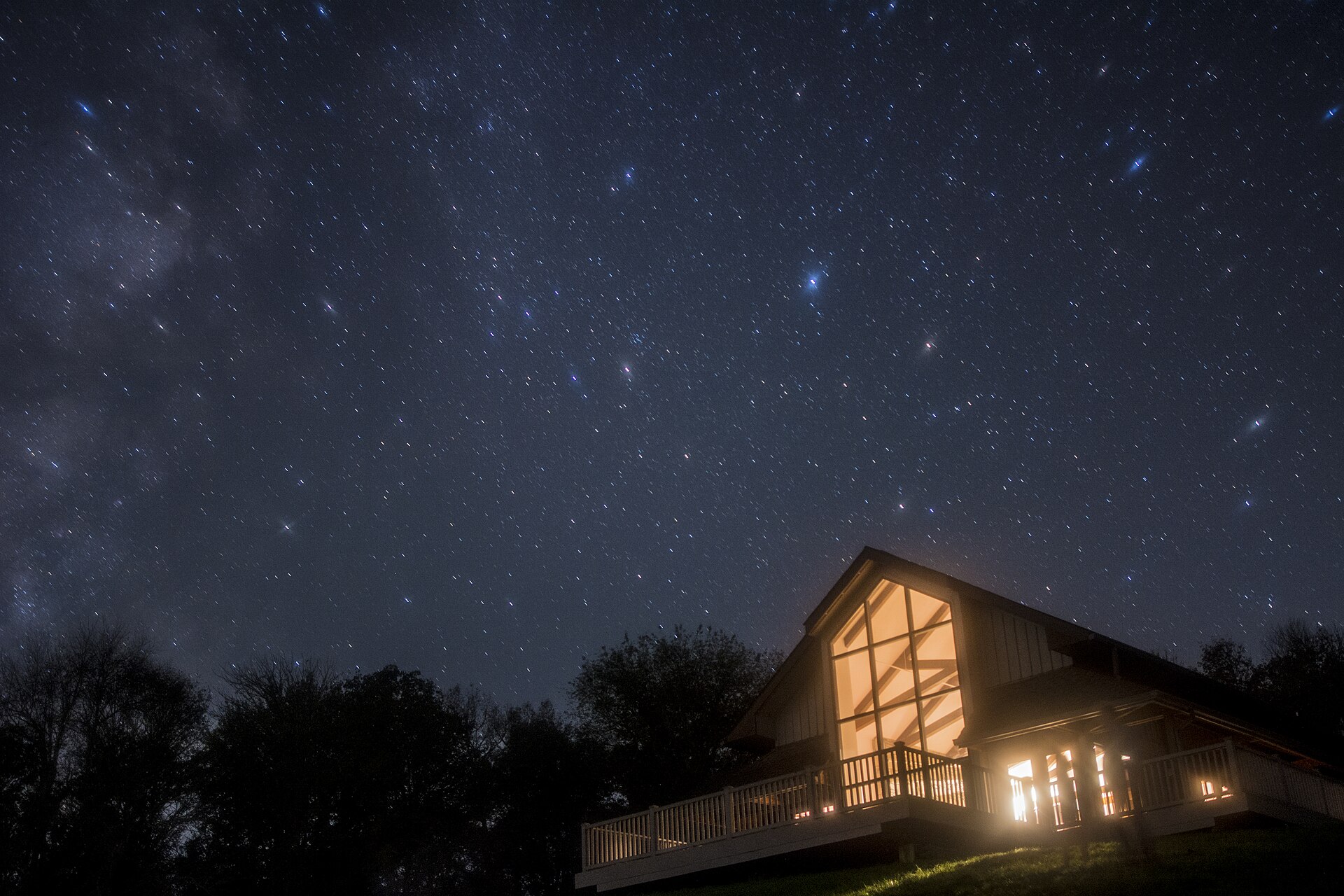
Most people east of the Mississippi have never seen the Milky Way properly. The reason is arithmetic: too many people, too many lights. Graham County runs the arithmetic the other way. The 2020 census counted 8,474 people in the whole county, about two-thirds of the land is Nantahala National Forest, and the town of Lake Santeetlah has roughly 50 year-round residents spread around 2,881 acres of water. There is no city glow to compete with. On a clear, moonless night here, the sky does what it did for most of human history: it fills up with stars.
That is not a figure of speech. About 80 percent of Lake Santeetlah's 76 miles of shoreline is U.S. Forest Service land, so most of the shore has no houses, no streetlights, and no dock lights at all. The darkness is the default condition.
Why it gets dark here
Light pollution falls off fast with distance, and the lake has distance in every direction. Robbinsville, the county seat, is six miles south and small. The next towns of any size, Bryson City and Andrews, sit behind mountain ridges in opposite directions. Between the lake and any significant cluster of lights there is almost always a 4,000-foot ridge doing the blocking.
The lake's own geography helps too. At a surface elevation of about 1,932 feet, you are above the valley haze that softens the sky in lower country, and the water gives you an open horizon that the forest usually takes away. From a dock or a south-facing cove, you get sky from treeline to treeline.
Milky Way season
In the Northern Hemisphere, the Milky Way is visible from about March through October, but the bright galactic center, the part that looks like lit smoke, is a spring-through-summer feature. The peak months run from April through the end of July, when the center is up for much of the night. In June and July it arcs high overhead by late evening; by September it stands in the southwest after dark and sets earlier each night.
From the lake, the summer view is south across the water. Give your eyes a full 20 minutes away from phone screens and porch lights before you judge it. The faint band sharpens the whole time your eyes adjust, and binoculars, even ordinary ones, will pull individual star clouds out of it.
The two meteor showers worth planning around
- Perseids, peaking August 12–13. The most reliable warm-weather shower. Under a genuinely dark sky, counts run from 50 up to about 100 meteors an hour near the pre-dawn peak, and August nights at the lake are warm enough to watch from a dock chair or a paddleboard pulled up on shore. Rates build after midnight, when the radiant in Perseus climbs higher.
- Geminids, peaking December 13–14. The strongest shower of the year, capable of 100 to 120 meteors an hour under dark skies, with the best rates after midnight. December at the lake has one odd advantage: the seasonal drawdown, which can drop the water up to 10 feet between December and March, leaves a wide band of exposed shoreline to set up on. You will want every layer you own.
For both showers, the moon matters more than the calendar. A shower peak that lands near a full moon is a fraction of itself. Check the lunar phase when you book, and favor the new moon weekends in between for plain stargazing.
Where to set up
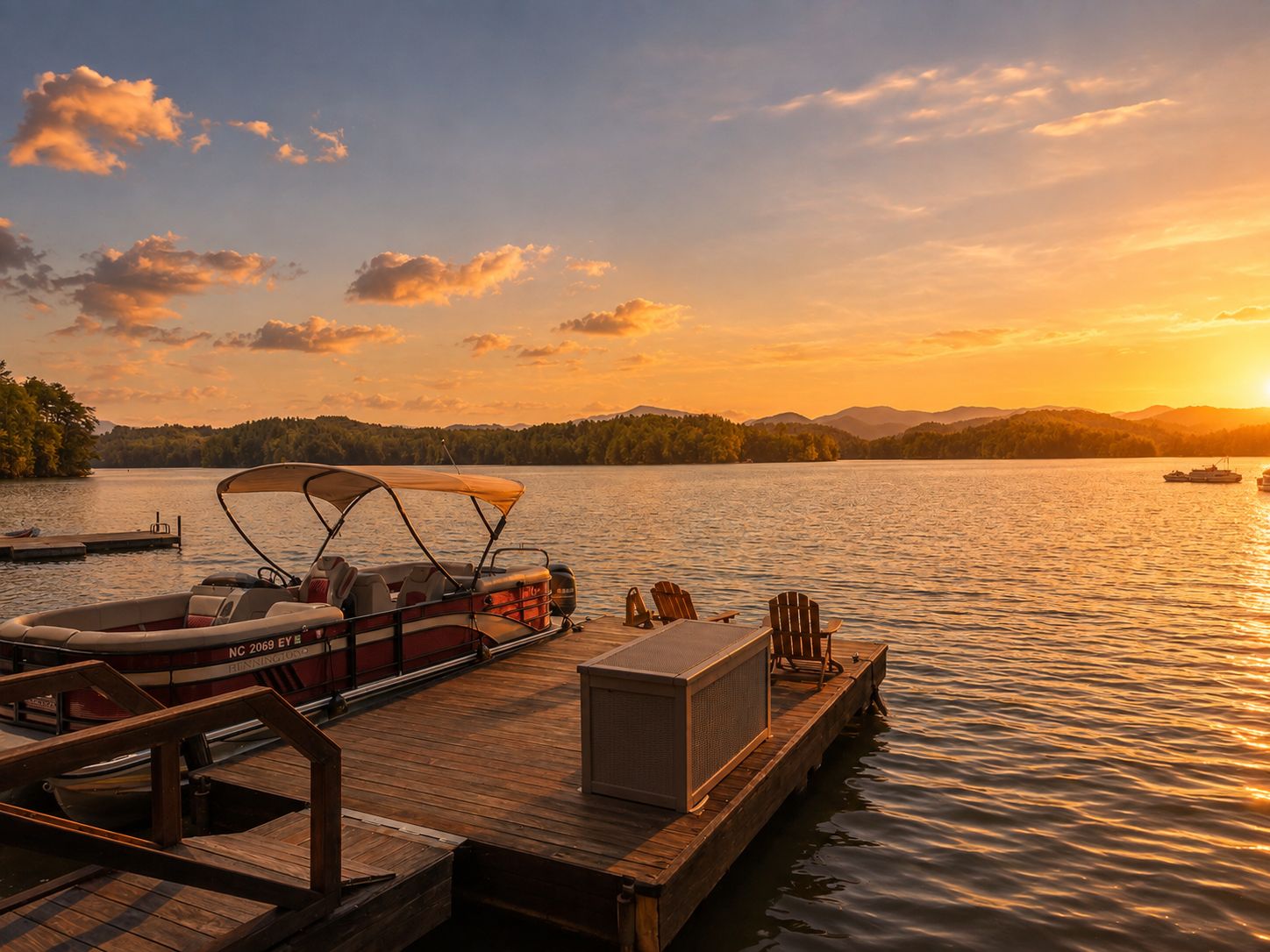
Your own shoreline. The dock at 4 Lakeside Trail faces open water, and it is hard to beat a viewing spot that is thirty steps from the kitchen. Kill the house lights behind you and let the lake be the horizon.
Cherohala Skyway overlooks. The Skyway climbs from the lake's south shore to 5,390 feet at Santeetlah Overlook, and the high pull-offs put you above most of the low haze with nothing around you. There is no gas, food, or restroom on the road itself, and it is cold at that elevation after dark in any month. Go up before sunset, watch the light leave, and drive down carefully. Our Cherohala Skyway guide covers the overlooks in order.
Fontana Dam. The long, open top of the dam is another local favorite: a flat, rail-lined walkway with water on one side and the Smokies on the other, and almost no lights of its own.
Practical notes
- Darkness is a season too. Fall and winter nights start earlier and the air is usually clearer than in summer humidity, so October through February gives the longest viewing windows.
- A red flashlight preserves night vision; a phone at full brightness resets your 20 minutes of eye adjustment in one glance.
- The lake sits in a weather pattern of its own. A cloudy forecast for Robbinsville does not always mean clouds over the water, and the Skyway overlooks are frequently above a cloud deck that fills the valleys. It cuts both ways, so look up before you write the night off.
Keep reading
- Joyce Kilmer Memorial Forest: 400-Year-Old Poplars on a 2-Mile Figure-Eight Trail
- Fall Color Around Lake Santeetlah: Peak Timing by Elevation and a Drive That Climbs Through All of It
- Lake Santeetlah Basics: 2,881 Acres and 76 Miles of Shoreline
- 48 Hours at Lake Santeetlah: A Weekend Itinerary
Common questions
Can you see the Milky Way from Lake Santeetlah with the naked eye?
Yes, on a clear night with little or no moon, from roughly March through October. The bright galactic center shows best from April through July, standing in the southern sky over the water.
When is the best single night of the year for stargazing at the lake?
A moonless night near the Perseid peak on August 12–13 is the strongest combination of warm weather, a major meteor shower, and the Milky Way overhead. The Geminids on December 13–14 produce more meteors but much colder watching.
Do I need a telescope?
No. Meteor showers and the Milky Way are naked-eye events, and a telescope actually narrows your view too much for both. Bring a reclining chair, a blanket, and binoculars if you have them; that is the whole kit.