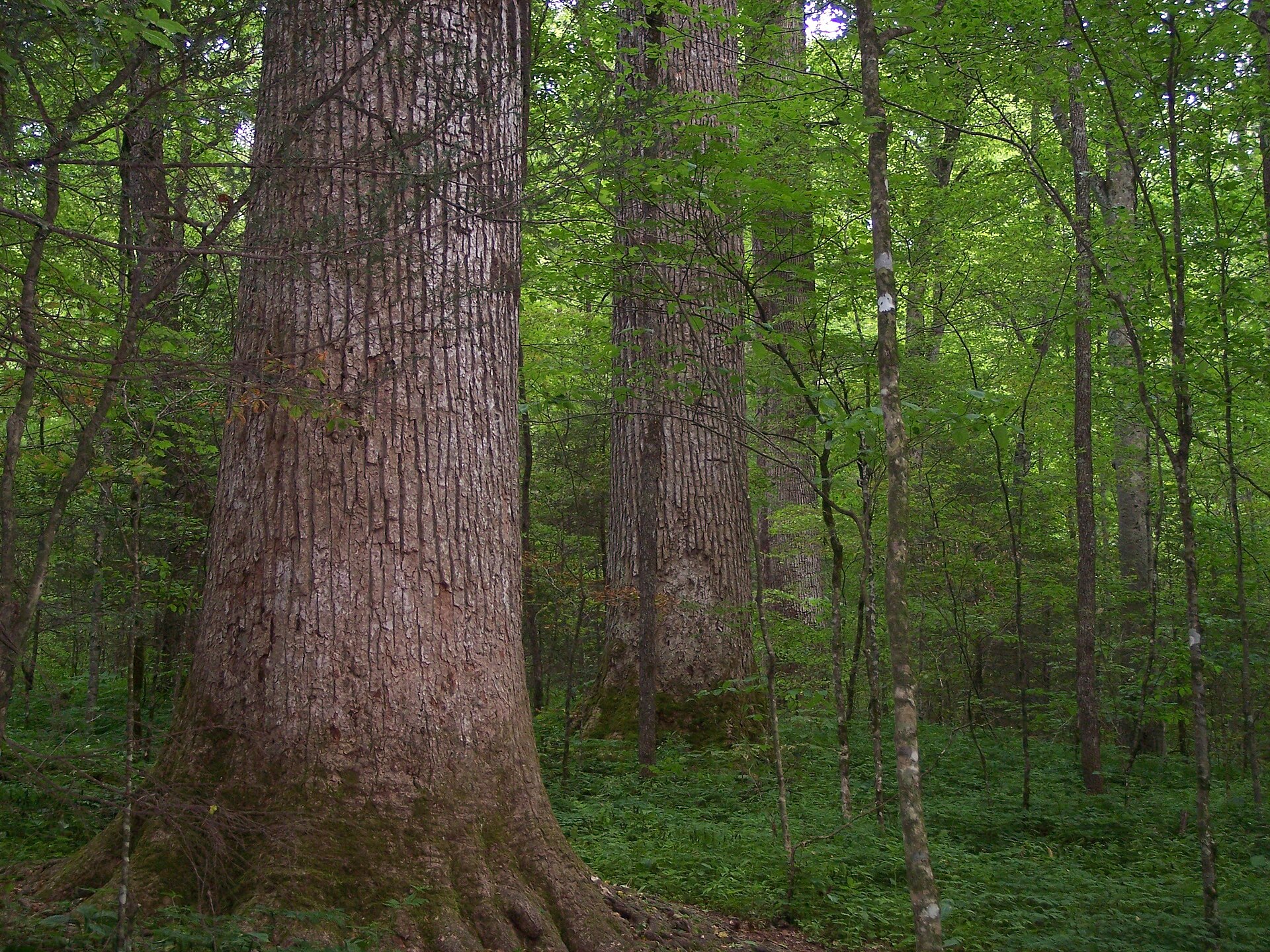
Most of the big timber in the southern Appalachians was cut a century ago. Joyce Kilmer Memorial Forest is the piece that got away. This 3,800-acre tract along Little Santeetlah Creek holds tulip poplars that were already old when the United States was founded: trees more than 400 years old, up to 20 feet around and 100 to 140 feet tall, in one of the largest stands of old-growth forest left in the eastern United States.
It sits in the Unicoi Mountains of Graham County, about a 30-minute drive from Robbinsville and a short hop from Lake Santeetlah's west end. The only way in is on foot. There is a picnic area and a restroom at the trailhead, a paved road to the parking lot, and a 2-mile trail. That is the whole attraction, and it is enough.
A memorial to a poet
Joyce Kilmer was a journalist and poet whose 1913 poem "Trees" became one of the most widely read poems in America. He enlisted in World War I and was killed in France in 1918. In 1934, the Bozeman Bulger Post of the Veterans of Foreign Wars in New York petitioned the federal government to set aside a stand of trees as a living memorial to him.
The Forest Service looked at forests across the country and chose this one: an uncut 3,800-acre tract on Little Santeetlah Creek. It was dedicated as the Joyce Kilmer Memorial Forest on July 30, 1936. In 1975, the forest became part of the larger Joyce Kilmer-Slickrock Wilderness, which protects more than 17,000 acres of the surrounding mountains.
How the forest survived the saw
The trees were not saved by sentiment. They were saved by geography, bad luck for the loggers, and a market crash. The memorial forest grows in a rugged cove that was hard to reach, and when the Babcock Lumber Company of Pittsburgh began working the Slickrock Creek watershed in 1915, it cut about two-thirds of that watershed but never got this cove cut. Construction of Calderwood Dam downstream threatened the company's railroad, lumber prices collapsed in the Great Depression, and the poplars were still standing when the Forest Service came looking for a memorial in the 1930s.
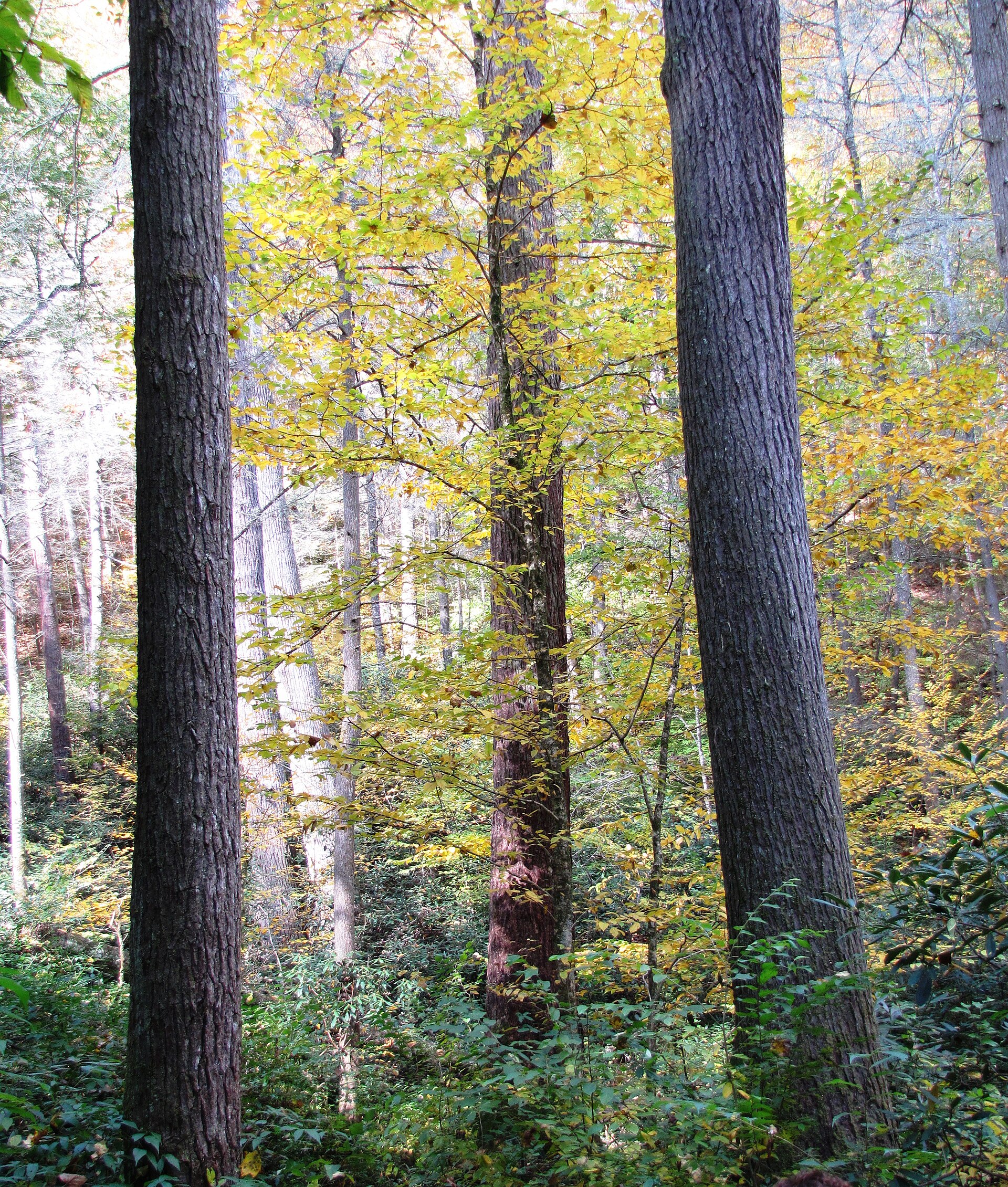
The result is a forest of more than 100 tree species: tulip poplar, oak, sycamore, beech, and hemlock among them. Poplar Cove, on the upper loop of the trail, is where the giants are. Fallen trunks lie where they dropped, some of them wider than a person is tall, going back to moss and soil on the forest's own schedule.
The figure-eight trail
The trail is a 2-mile figure eight, and the two loops have different characters. The lower loop runs 1.25 miles along the creeks, comparatively level, under big trees the whole way. The upper loop is 0.75 mile and climbs into Poplar Cove, where the largest tulip poplars stand. A memorial plaque to Kilmer sits at the junction of the two loops.
Do the whole figure eight if you can; it takes most people about an hour at a wandering pace. The upper loop is the part people talk about afterward. Foot traffic only: no bikes, no horses, no camping along this trail. Go on a weekday morning and you may have the cove to yourself.
Beyond the loop
The memorial trail is the front porch of a much bigger place. The Joyce Kilmer-Slickrock Wilderness covers 17,394 acres across the North Carolina and Tennessee line, drained by Little Santeetlah Creek and Slickrock Creek. Long routes like the 13.3-mile Slickrock Creek Trail trade the memorial's groomed loop for steep climbs and repeated creek crossings, and the trails climb to Bob Stratton Bald, a grassy bald at 5,360 feet on the wilderness's southern edge. Backpackers use the memorial trailhead as a starting point; day visitors heading only for the big trees do not need to think about any of it.
Making a day of it
Joyce Kilmer pairs naturally with the other high ground around the lake. The Cherohala Skyway starts at Santeetlah Gap near the lake's south shore and climbs to 5,390 feet, and the drive to the forest trailhead passes close to the lake itself. If you are based on the water, at 4 Lakeside Trail or anywhere along the north shore, the forest is an easy half-day: drive over in the morning, walk both loops, picnic at the trailhead, and be back on the dock by early afternoon. For the lake's own story, see our guide to Lake Santeetlah basics.
Keep reading
- Waterfalls Near Robbinsville, NC: Yellow Creek Falls, Snowbird Creek, and Bald River Falls
- Dark Skies Over Lake Santeetlah: Stargazing, the Milky Way, and Meteor Showers
Common questions
How long is the Joyce Kilmer trail?
Two miles total, in a figure eight. The lower loop is 1.25 miles and the upper loop, through Poplar Cove, is 0.75 mile. Most visitors take about an hour.
How old and how big are the trees?
The largest tulip poplars are more than 400 years old, measure up to 20 feet around, and stand 100 to 140 feet tall. More than 100 tree species grow in the forest.
When was the forest set aside, and why?
It was dedicated on July 30, 1936, as a memorial to poet Joyce Kilmer, author of "Trees," who was killed in France in World War I. The Veterans of Foreign Wars had asked the government to preserve a stand of trees in his name.