Graham County was Cherokee country for centuries before it was a county. The names on the map still say so: Cheoah comes from the Cherokee word for otter, and the Snowbird Cherokee community at Tutiyi, in the Snowbird Mountains south of Robbinsville, is part of the Eastern Band of Cherokee Indians today. The county's best documented Cherokee life belongs to Junaluska, a man who fought beside Andrew Jackson, was deported by Andrew Jackson, walked home from Oklahoma, and is buried on a hill above Robbinsville.
This is a history with a documented core and a layer of later storytelling on top of it. Where the two differ, this guide says so.
Junaluska the ally
Junaluska was born around 1779 in the Cherokee town of Echoe, near present-day Dillard, Georgia. He was never a chief, but he spoke for the Cherokee in 1811 when he refused Tecumseh's request that the tribe join a war against the United States. In 1813, when the United States went to war with the Red Stick Creeks, he recruited about 100 Cherokee warriors to join the campaign.
At the Battle of Horseshoe Bend in March 1814, Cherokee fighters played a decisive part. Junaluska and his men swam the Tallapoosa River, took the Creeks' canoes, and used them to ferry warriors across to attack from the rear. Tradition goes further and credits Junaluska with saving General Andrew Jackson's life in the battle. North Carolina's state historians are careful here: no document supports the rescue itself, but the Cherokee role in the victory, and Junaluska's bravery in it, are on the record. His Cherokee name, Tsunulahunski, is usually rendered "one who tried but failed," a rueful reference to a promise he had made about destroying the Creek Nation.
Removal, and the walk home
In 1838, President Jackson's removal policy reached the North Carolina mountains. Junaluska was rounded up with the other Cherokee and sent west to Indian Territory. His wife and at least two sons died in the removal, according to the account in NCpedia. He survived the journey, and then he walked back, reaching North Carolina by 1843. Accounts recorded later put a bitter sentence in his mouth: "If I had known that Jackson would drive us from our homes, I would have killed him that day at the Horseshoe."
For three years he lived in his own homeland with no legal standing. In 1847 the North Carolina General Assembly passed a special act granting Junaluska citizenship, 337 acres of land at Cheoah, and $100, in recognition of his service in 1813 and 1814. The land, near present-day Robbinsville, was part of what had been his own property before the removal.
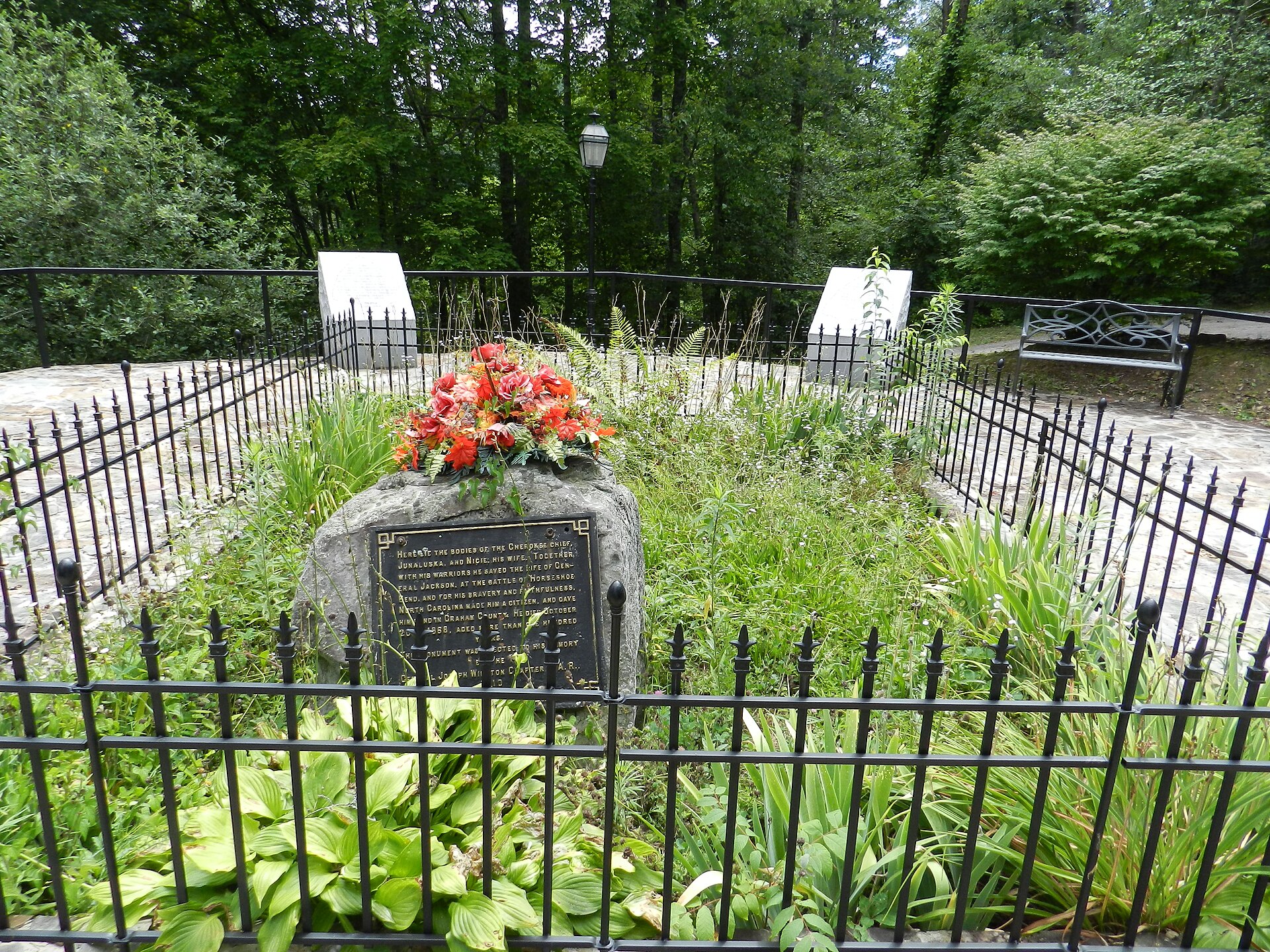
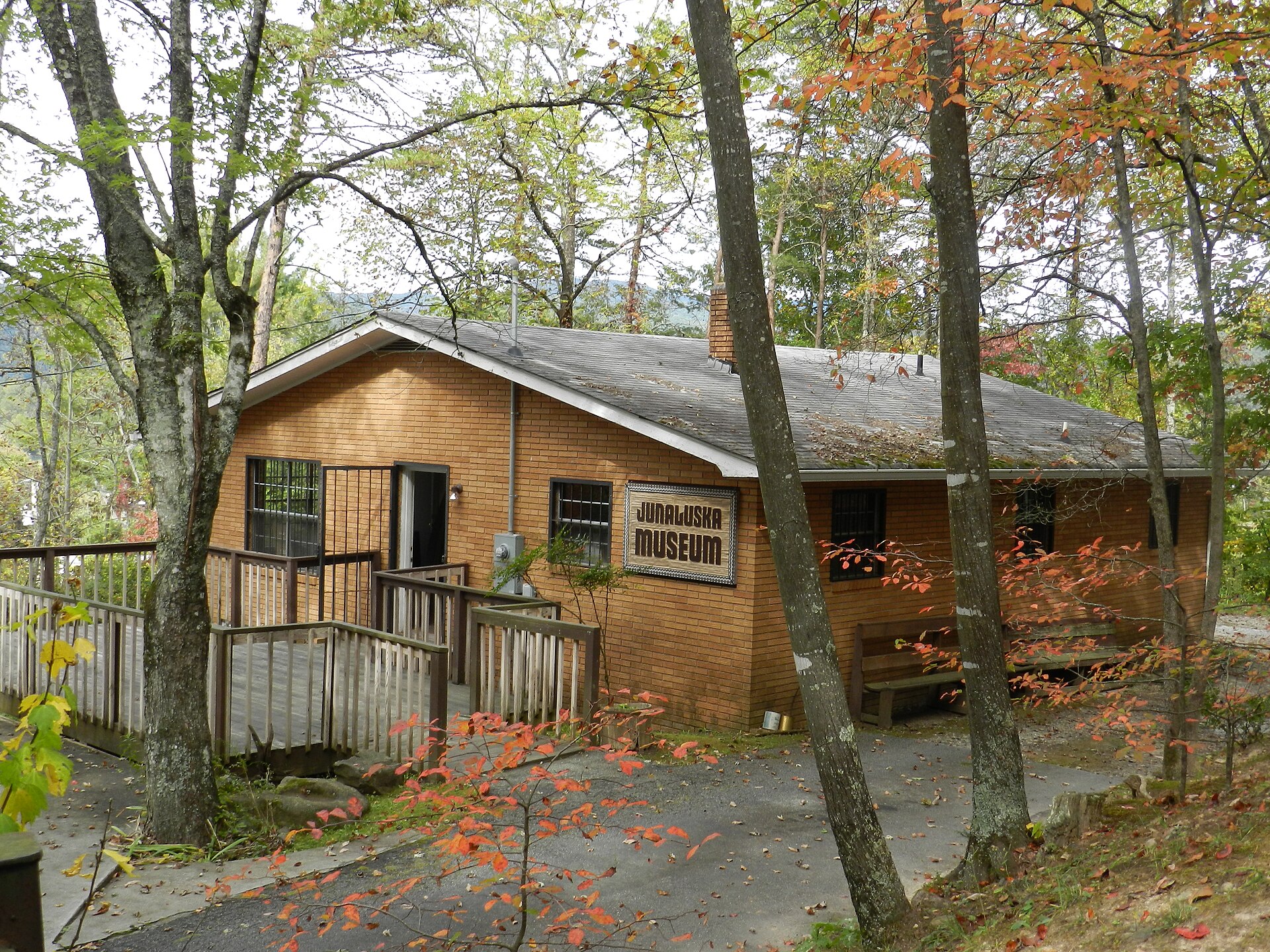
Junaluska died in 1858 and was buried beside his wife, Nicie, on his land, the grave marked with a pile of stones in Cherokee fashion. In 1910 the Daughters of the American Revolution put a bronze monument on the site; its inscription gives his death as 1868 and his age as over one hundred, both wrong by modern records. In 1997 the Friends of Junaluska added a seven-sided memorial with markers for the seven Cherokee clans. The gravesite on Junaluska Road in Robbinsville now includes a small museum and a quarter-mile medicine trail showing plants used in Cherokee medicine.
Tsali
The other name from 1838 is Tsali, a farmer who lived near where the Nantahala River meets the Little Tennessee. In May 1838 he went into hiding in the mountains with about twenty family members and neighbors rather than be removed. Cherokee oral tradition tells what happened when soldiers caught up with them: the group was harassed, a baby was killed, and Tsali's party ambushed the escort, killing one soldier and wounding two.
What followed is the documented core of the story. General Winfield Scott, commanding the removal, had neither the troops nor, by some accounts, the appetite to hunt down every Cherokee hiding in the Smokies. William Holland Thomas, a white lawyer adopted into the tribe as a boy, carried a message: if the men responsible for the attack gave themselves up, the hunt for the others would end. Tsali, his brother, and one of his sons surrendered. They were executed on November 25, 1838, by a firing squad made up largely of other Cherokee, an added humiliation that Tsali's youngest son, who was spared, later described. The highly dramatized version in the outdoor drama Unto These Hills, performed in Cherokee since 1950, departs from the record in a number of places.
Between 300 and 400 Cherokee remained in the North Carolina mountains after the removal. They, the Cherokee who had legal title to land, and those who later returned, formed the nucleus of what became the Eastern Band of Cherokee Indians.
The Snowbird Cherokee
Graham County's Cherokee community is Snowbird, called Tutiyi in Cherokee, in the Snowbird Mountains. Snowbird people are members of the Eastern Band, but Snowbird is a separate community from the Qualla Boundary towns an hour east, and it has its own character. Most strikingly, Snowbird speakers traditionally use the Overhill dialect of Cherokee, the dialect of the old Overhill towns and of the Cherokee in Oklahoma, rather than the Kituwah dialect spoken on the Qualla Boundary.
The Cherokee language is in danger everywhere it is spoken; fluent first-language speakers in the Eastern Band now number in the low hundreds. Snowbird has worked at keeping it. The late Shirley Oswalt, a Beloved Woman of the Eastern Band and a first-language speaker, founded the organization that became the Snowbird NEST program in 2013 to teach the language and traditions to Snowbird children. On Main Street in Robbinsville, the Snowbird Cherokee Matriarchs Mural honors eleven Snowbird women, basket makers, beadworkers, and language keepers among them. Between the mural, the Junaluska gravesite and museum, and the living community at Tutiyi, Graham County's Cherokee history is not only a story about the past.
Keep reading
- Stecoah Valley Center: Bluegrass in a 1926 Rock Schoolhouse, and Eating Local in Graham County
- The Town of Lake Santeetlah: 38 Residents, 200 Homes, One Long Water Fight
- Joyce Kilmer Memorial Forest: 400-Year-Old Poplars on a 2-Mile Figure-Eight Trail
- A Smoky Mountains Day Trip from Robbinsville: Oconaluftee, Newfound Gap, and Kuwohi
Common questions
Who was Junaluska?
A Cherokee leader, born around 1779, who fought with Andrew Jackson against the Red Stick Creeks and played a decisive role at Horseshoe Bend in 1814. Removed to Indian Territory in 1838, he walked back to North Carolina, and in 1847 the state granted him citizenship and 337 acres near present-day Robbinsville.
Where is Junaluska buried?
On a hill in Robbinsville, on Junaluska Road, beside his wife Nicie. The site has a 1910 DAR monument, a seven-clan memorial added in 1997, a small museum, and a medicine trail.
Who are the Snowbird Cherokee?
An Eastern Band of Cherokee Indians community at Tutiyi in the Snowbird Mountains of Graham County. They are known for keeping Cherokee traditions and for speaking the Overhill dialect, distinct from the Kituwah dialect of the Qualla Boundary.